Use search to find a topic, choose a category from the sidebar, or sort by title and date.
Kumo-Tabular vs tuned boosting and LDA: a small benchmark, plus why data preparation, interpretability and serving cost still matter.
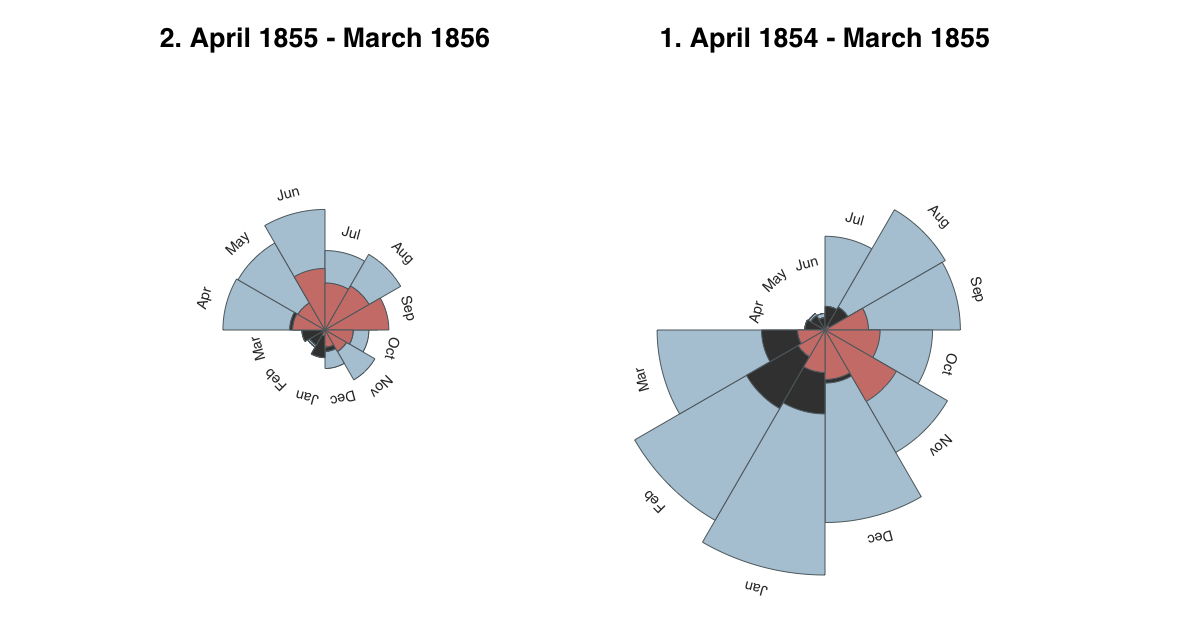
Florence Nightingale’s rose diagram in an 1859 copy of England and Her Soldiers: what it shows, what it cannot prove, and how to recreate it in R.
Lessons from delivering AI-assisted statistical-programming products: why AI agents make working code easy but the right product is still hard, with a gridify case study.
Are em dashes a sign of AI-generated text? A Python analysis of 100 top Project Gutenberg books finds em dashes in every book once double hyphens are counted.
There is no global CRAN download count. What cranlogs measures and misses, how to get proxy counts in R, and better metrics for R package usage.
How Transformers and large language models work, encoders versus decoders, and what you learn in the free Hugging Face LLM course, with pipeline examples.
A practical approach to vibe coding with AI assistants: modular design, test-driven validation, recommended tools and models, and what to do when it goes wrong.
Why Visual Studio Code is a complete toolkit for data scientists: Python and R extensions, GitHub Copilot, settings as code and reproducible devcontainers.
A practical guide to residual diagnostics for logistic and Poisson GLMs in R: raw, Pearson, deviance and quantile residuals, and how to spot misspecification.
Why no U.S. Air Force pilot was average: the 1950s cockpit study as a lesson in the curse of dimensionality, with a multivariate normal simulation in R.
What open source means, how projects like Linux work, common open source licenses, governance models, and the different ways you can contribute.
How to create flowcharts, sequence diagrams, Gantt charts and Sankey diagrams with Mermaid in Markdown, plus tools, alternatives and help from LLMs.
How WebAssembly runs R and Python in the browser at near-native speed, and how webR, Pyodide, Shinylive and Quarto use it for interactive data science.
What Python Enhancement Proposals (PEPs) are, how the PEP process works, and the PEPs that shaped Python: PEP 8, PEP 20, PEP 484, PEP 572 and PEP 621.
An in-depth guide to object-oriented programming for data science developers, with classes and design patterns from scikit-learn and pandas in Python.
An in-depth guide to Docker, Podman and Apptainer containers for data scientists: Dockerfiles, images, CLI commands and reproducible R and Python environments.
Conjugate priors give closed-form Bayesian posteriors. Beta–Binomial, Gamma–Poisson and Normal–Normal examples in R show how beliefs update with data.
How the Bernstein–von Mises theorem links Bayesian posteriors and frequentist confidence intervals in large samples, with a worked Normal–Normal example in R.
Why Suraj Gupta’s How R Searches and Finds Stuff is still essential reading for understanding R environments, namespaces and scoping rules.
An introduction to graph databases, property graphs versus RDF, common use cases and tools, and GQL, the new ISO standard query language for graphs.
Agile is a philosophy and Scrum is one framework for it. A guide to the Agile Manifesto, its twelve principles, and applying Agile beyond Scrum.
The tinyverse approach to R package development: why minimal dependencies improve stability, how it compares with the tidyverse, and how to reduce dependencies.
How to use the annual Stack Overflow Developer Survey for strategic tech planning: reading the demographics, following trends and spotting rising technologies.
ggcall makes ggplot2 code reproducible inside R packages by recording the plot-building call, using metaprogramming to override ggplot() and the + operator.
How GitHub Codespaces provides ready-to-use cloud development environments, how .devcontainer files keep setups consistent, and example R and Python codespaces.
How to set up pre-commit hooks for R and Python projects to run linters and checks before every Git commit, including automated fixes with pre-commit.ci.
What the free GitHub Student Developer Pack and Teacher Pack include, such as Copilot, Codespaces and GitKraken, and how students and educators can get them.
An R knapsack analysis and a modular arithmetic proof show that no subset of 1,002 sampled Kasa Romana coupons reaches the tested targets of 100 to 1,000.
Why the ASA statement and Frank Harrell call for moving beyond p-values, and why effect sizes and confidence intervals should be reported alongside them.
Why Git remains the standard for version control, the fewer than 20 commands you need, CLI versus GUI tools, and how Git differs from GitHub.